
The Odyssey - Beyond Myth, Beyond Spectacle
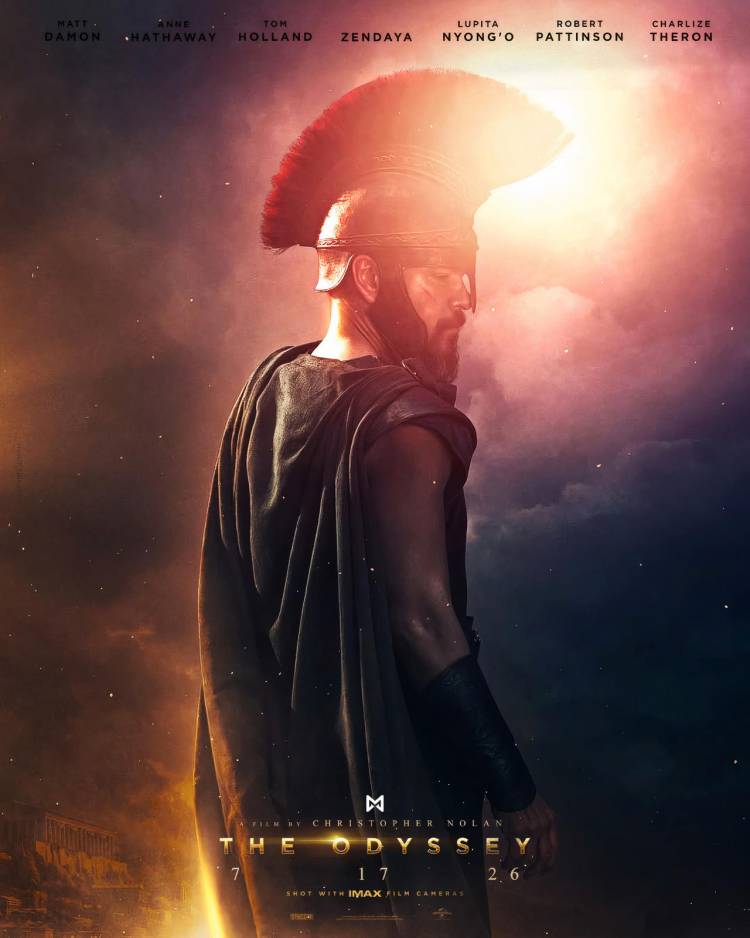
"A Time of Apparent Magic."
Christopher Nolan opens The Odyssey with those words, and the more I have thought about them since leaving the theatre, the more they seem to describe not merely the world of the film, but the achievement of the film itself.
This is going to be a long reflection rather than a conventional review. But if you love cinema, storytelling, Christopher Nolan, or simply the experience of sitting in a dark theatre and allowing yourself to be transported into another world, I hope you will find something worthwhile in these thoughts.
The apparent magic of The Odyssey is not found in the gods, monsters, prophecies or mythical creatures that populate Homer's epic. It lies in something far more difficult to achieve. It lies in Christopher Nolan's ability to take one of humanity's oldest stories and make it feel immediate, intimate, emotionally alive and HUMAN.
For years, I had encountered fragments of Greek mythology through books, animated adaptations, documentaries, television series and films. The Sirens, the Cyclops, Circe, Calypso, the Trojan Horse, the impossible voyage between monsters and whirlpools—these stories have existed in popular culture for so long that they almost feel detached from their origins. We know them. We recognize them. We think we understand them.
And yet, somehow, Nolan makes them feel new again—not because he reinvents them through spectacle, but because he finds emotional truth within them. That distinction is what separates The Odyssey from almost every modern mythological epic I can think of. Most filmmakers would look at Homer's text and immediately see opportunity for visual extravagance. The Cyclops alone could have become a twenty-minute showcase sequence. The Sirens could have been introduced with operatic grandeur. The whirlpool could have been photographed from impossible angles to emphasize its scale. Every encounter on Odysseus' journey contains enough material to become a standalone blockbuster.
Nolan chooses a different path.
The film never diminishes these mythical elements, but it rarely presents them as attractions. The Sirens remain distant, elusive and almost hauntingly understated. The whirlpool is experienced not through its enormity but through the terror and uncertainty of those attempting to survive it. Most surprisingly, the Cyclops sequence avoids turning the creature into a centrepiece. We do not remember the Cyclops because Nolan makes it terrifying. We remember it because of what Odysseus chooses to do, and the emotional and moral consequences that follow.
Every encounter could have been spectacle. Nolan turns them into character.
This approach reaches one of its most fascinating expressions in the Circe episode. In lesser hands, Circe would simply be another obstacle, another fantastical figure encountered on the long journey home. Instead, the film grants her an emotional interiority that lingers long after the sequence ends. Samantha Morton delivers one of the film's most memorable performances despite her relatively limited screen time, imbuing Circe with a profound weariness and deep-seated resentment toward men. When Odysseus confronts her, the sequence becomes less about magic and more about understanding. Morton never plays Circe as a mythical villain. She plays her as someone who has seen the worst of humanity for so long that she has ceased believing in its capacity for goodness. It is a remarkable performance, and one that perfectly encapsulates Nolan's approach to the material: before asking us to marvel at a legend, he asks us to understand the person behind it.
If there is a recurring thread running through every major decision Nolan makes as a filmmaker here, it is an insistence on understanding before judging, and nowhere is that more apparent than in the way he portrays Odysseus himself.
Matt Damon delivers what I genuinely believe is the finest performance of his career.
Makeup can age a face. Performance ages a soul.
By the time we spend significant time with Odysseus, we are not looking at a conquering hero returning from war. We are looking at a man carrying the accumulated weight of twenty years of responsibility, loss, regret and consequence.
The brilliance of Damon's performance lies in how little of this is spoken aloud. It exists in his posture, in his silences, and in the exhaustion etched across his face. The film could easily have celebrated Odysseus as a legendary warrior whose intelligence changed the course of history. Instead, it presents him as a man forced to live with what that intelligence ultimately cost. That burden becomes the emotional engine of the entire film. The Odyssey is not merely about a man trying to get home; it is about a man trying to decide whether he knows how to live with himself once he gets there. It is about carrying the weight of decisions whose consequences extend far beyond the individual who made them.
The film's understanding of consequence extends beyond Odysseus himself. Himesh Patel is excellent as Eurylochus, the loyal companion who follows Odysseus through unimaginable hardship before finally confronting the cost of the choices being made around him. Patel brings quiet conviction and growing disillusionment to the role, reminding us that the burden of great decisions is rarely carried by great men alone. And this is a small example of how much Nolan pours into his writing to make every single frame, character and scene speak for itself.
Anne Hathaway delivers what I consider the emotional heart of the film. Her Penelope is not defined by waiting but by endurance. Lesser adaptations often reduce Penelope to a symbol—a faithful wife patiently awaiting her husband's return—but Hathaway transforms her into something far richer. Every scene carries the weight of two decades spent holding together a kingdom, a household and a family while refusing to surrender hope. What impresses most is the restraint of the performance. She rarely reaches for grand emotional gestures, communicating instead through quiet resilience and subtle vulnerability. The longer the film progresses, the more one understands that Penelope's journey is every bit as arduous as Odysseus'. One battles storms and monsters. The other battles uncertainty, loneliness and time itself.
Tom Holland is equally impressive as Telemachus. His performance captures the strange contradiction at the centre of the character. He misses a father he barely remembers and longs for a relationship that exists more as an idea than a memory. Holland portrays that yearning beautifully, making Telemachus' hope and frustration feel deeply authentic. Robert Pattinson brings complexity and conviction to Antinous, Charlize Theron lends Calypso a quiet melancholy, while Zendaya as Athena, Elliot Page as Sinon and the rest of the ensemble ensure that even the film's smaller roles feel fully inhabited. Across the board, the performances give emotional weight to a world that could easily have been overwhelmed by mythology and spectacle.
One of the film's most remarkable achievements is how physical it feels. For perhaps the first time in a mythological epic, I found myself genuinely sensing the effort required to live in that world. Whether it is soldiers cramped inside the Trojan Horse, men straining to open the gates of Troy, ships being rowed across hostile seas or warriors carrying the weight of armour and survival itself, the film constantly reminds us that this civilization was built through human labour. The monuments feel monumental because one can feel the effort required to create them.
That sense of physical authenticity extends beautifully into Hoyte van Hoytema's extraordinary cinematography. Much has already been said about The Odyssey being the first feature film photographed entirely using IMAX cameras, but what impressed me most was not the scale of the imagery but its intimacy. The vast landscapes are undeniably spectacular, but the true revelation lies in the faces. The format captures every crease, every scar, every flicker of hesitation and every moment of uncertainty with astonishing clarity which all become part of the storytelling.The closer the camera gets to its characters, the more the mythology begins to disappear, leaving only people carrying grief, hope, responsibility and the consequences of decisions made years earlier.
Ludwig Göransson's score deserves special mention. Rather than functioning as a conventional blockbuster soundtrack, it feels as though it emerges from the world itself. The recurring male choral voices create a haunting sense of longing, grief and isolation, while the percussive textures evoke the sounds of a distant Bronze Age civilization. Together they form an emotional undercurrent that quietly carries the film through its moments of wonder, sorrow and reflection.
Jennifer Lame's editing, the production design, art direction, costume design and countless other crafts work in remarkable harmony. Every department appears aligned to the same vision, creating a world that feels both mythological and lived-in while never losing sight of the people at its centre.
Which ultimately brings me back to where this reflection began: "A Time of Apparent Magic."
For three hours we sit in a dark room watching light projected onto a screen. We know none of it is real. We know we are watching actors, sets, costumes, music and images carefully assembled by hundreds of artists. And yet we believe. We care. We grieve. We hope. We allow ourselves to be transported - "A TIME OF APPARENT MAGIC".
Christopher Nolan is one my favourite filmmakers. My personal affection for The Dark Knight Trilogy will probably never disappear. It remains my biased favourite among Nolan's films because of my love for Batman and Nolan's extraordinary reimagining of that world. I personally think Interstellar is his most emotionally resonant film—a work that managed to balance spectacle and feeling in a way few filmmakers have ever achieved. More recently, Oppenheimer receiving all the praise and accolades, demonstrating 25+ years of the filmmaker's illustruous career of making brilliant movies.
And yet, The Odyssey has somehow surpassed them all—not because it is bigger, louder or more ambitious, but because it feels like the fullest expression of everything Nolan has been exploring throughout his career. Time. Memory. Regret. Sacrifice. Responsibility. The endurance of love. The consequences of our actions. The search for meaning. All of those themes converge here with a confidence and maturity that feels extraordinary. Under Nolan's stewardship, an exceptional cast and crew have created something that feels less like another great film and more like the culmination of decades of artistic growth.
His ability to take a mythical epic and make it feel profoundly human is what ultimately separates it from so many films of comparable scale. It reminds us why stories endure, why myths survive and why we still sit in dark theatres hoping to be transported somewhere beyond ourselves.
Epic in scale. Profound in emotion. Pure cinema.
- A Cinephile's Reflection by Kishore